
As the digital landscape continues to evolve, the role of developer marketing has gained immense importance. It’s a unique and rewarding position that combines technical expertise with creative communication. Even if you don’t have years of technical expertise, you can still thrive in this role with passion for tech, curiosity and willingness to learn.
In this blog post, I’ll delve into what my role as a developer marketer at aiven.io, how it looks like and what skills I’ve learned that I think every marketer should posses. At the end of this post you’ll also find a curated list of good resources to learn more.
Understanding the Developer Marketer Role
You have to understand your target audience well in any marketing role but when working with tech and developers you need to really know your audience well and put maybe slightly more time and effort on learning about the users and their pain points. This marketing role as any other can include different areas of responsibility depending on the company.
In my role the key responsibility areas have been:
- Be the marketing partner for Developer Relations team: This team consists of developer advocates and developer educators, they are often developers that now the tech, I know marketing = we are a perfect match 😊 Together we plan the strategy and quarterly campaigns. I lead the strategic planning and make sure our campaigns/projects run in the given timeline and budget, analyze the results and optimize the actions and suggest new things based on data.
- Content Management and coordination: DevRel team produces most of the long form content. See few examples here: Tutorial: TensorFlow, PostgreSQL®, PGVector & Next.js: building a movie recommender or an online workshop: Learn Apache Kafka with Python. I play a key role in planning how we distribute different types of content, how we put the information to our website, how we optimize it for search engines (SEO), how we lead the user forward and how we improve conversion rates. I also plan what kind of content fits to what channel, how our ad copies or website content looks like. As an example of a bigger project, I was responsible of operationalizing our workshops.
I also plan and even write nurturing emails or shorter web content myself as long as my technical understanding is adequate. Often I know enough what this is important but then I go and ask our developer advocates for the juicy technical details to highlight. - Advertising: Developers hate ads? Well not really if you remove the marketing lingo and focus on solving problems and help devs learn something cool. You need to be clever how you do ads and where you place them. Many developers do block ads and remove cookies so also tracking can be tricky. In collaboration with performance marketing team I plan quarterly ads related to specific topics, we have always-on re-targeting and search ads for different stages of the funnel.
- Measuring results: Data-driven decision-making is key in modern marketing. I analyze metrics to understand the impact of my efforts and improve & change things based on what I see. My primary objective is to consistently boost the monthly influx of new users and engage with existing. While we monitor various metrics, one key focus is also assessing the quality of acquired users which is usually measured by their activity.
Developers are not the final decision makers but they do have a lot of influence in companies when it comes to choosing the right tools and infrastructure. Hence we also track the pipeline influence in Salesforce where we actually track all our campaigns. Combined with established UTM tracking and user fingerprinting on our website , we can gain valuable insights into user behavior. Analyzing campaign performance constitutes a significant part of my daily responsibilities.
In addition, I collaborate with our community & brand team and plan how we get more users to our community. During Aiven’s rapid growth my responsibilities have varied. When our marketing team was smaller, I also did user research. Directly conversing with users provided a fascinating insight into their perspectives, language, and product preferences. Using this firsthand knowledge has been integral to shaping my work. Moreover, a comprehensive grasp of the entire user journey, including those pivotal ‘Aha!’ moments, is indispensable. This understanding is instrumental in leveraging this information for marketing initiatives, facilitating the conversion of free/trial users into paying customers, and ensuring their retention. To gain this knowledge, I sync regularly with our product team.
Given our sizable team, a significant portion of my daily tasks involves collaborating with various internal stakeholders. Effective communication and comprehensive documentation are pivotal aspects of my role. Success is contingent on seamless collaboration, ensuring that each team is well-informed about the activities of others.
I consistently allocate time for continuous learning by engaging with industry articles, newsletters, and following influential figures in the marketing field. Additionally, I make a concerted effort to stay current by attending relevant industry events, such as the Kafka Summit. These opportunities not only allow me to stay updated on industry trends but also provide valuable insights through interactions with competitors, partners, and developers.
Summa summarum, role is very versatile and it helps when you posses many different skills 🦄
Navigating Developer Marketing Successfully
When it comes to developer marketing, understanding what developers tend to avoid is as important as knowing what appeals to them. To capture a developer’s interest, your offering must be genuinely valuable. It should either solve a problem in their daily lives or be so intriguing that they can’t resist exploring it. Developers appreciate straightforward, practical, and frictionless experiences. Here’s how to do it:
1. Steer Clear of Fluff and Marketing Jargon
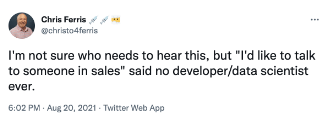
Developers are no-nonsense individuals. They value concrete information and facts over vague marketing lingo. When crafting your content, be direct and transparent. Offer them substance, not just style. They want to know how your product or service can solve their problems or enhance their work.
2. Provide Practical Solutions and Hands-On Experience
Developers thrive on practicality. They appreciate tools, guides, and resources that allow them to get hands-on and test things themselves. If you can offer them practical solutions and tools that simplify their work, you’re on the right track. Demonstrations and real-world use cases can be particularly appealing.
3. Minimize Friction in the User Experience
One thing developers can’t stand is unnecessary friction. Long forms, complicated sign-up processes, or intrusive data requests are immediate turn-offs. Keep the user experience smooth and hassle-free. If you need to collect information, make it clear why and how it benefits the user.
4. Make Value Clear Before Asking for Information
Developers are cautious about sharing their email addresses. They’ll do so only if they see clear value in what you’re offering. Gated webinars and e-books, while valuable, may not be their first choice. Make sure the value is evident before asking for personal information. Explain how your content or product can directly benefit them.
Rewards: What makes the developer marketing role enjoyable
Being a developer marketer can be incredibly enjoyable for several reasons:
- Constant Learning: Technology is ever-evolving. Developer marketers get to stay on the cutting edge of tech trends and continually enhance their knowledge. Tech start-ups move and change super fast so we always joke around that you learn 6x times more in a company like this than in a more established company with stable revenue flows and processes.
- Creative Problem-Solving: This role demands creative solutions to connect with a technically minded audience. Finding innovative ways to communicate complex technical concepts is both challenging and satisfying.
- PLG: Developer marketing is bottom up. Developers come and try out the product, see the benefits and tell their friends. They have a huge influence on buying decisions and when developers are involved customers are also often stickier.
- Good data tools and analytics. It’s amazing how much data there is to inform your decisions when you just know what to ask. I can independently or with the help of our analytics team do a analysis with different tools and do my own reports in Superset and Salesforce. which is crucial so I can see the impact of my work. While this may not be particularly pertinent only in developer marketing, it is a facet of my work that I genuinely enjoy and value
Whether you’re an aspiring developer marketer or someone curious about the role, I can ensure you that the journey is as rewarding as the destination. I don’t know if I will be developer marketer forever but I know that all the things I’ve learned here are valuable in which ever data driven marketing role I might pursue 🚀
Resources to learn more
If you are into developer marketing, here’s some great resources to read and follow:
⭐ Book: Developer Marketing Does Not Exist, Adam DuVander
⭐ https://www.developermarketing.io > They have a Slack channel where you can connect with other developer marketers 💎 You’ll find me there as well.
⭐https://www.developermarkepear.com/
⭐ See also this discussion: https://news.ycombinator.com/item?id=32191615#32196899
⭐ Great panel discussion in Developer Marketing Summit that I think fits well if you are still quite new in dev marketing. Katie Miller (Director of Developer Marketing at Slack), Elizabeth Kinsey (Director of Community at Slack), Katy McCreery (Product Manager at Asana), and Aja Hammerly (Developer Relations Manager at Google) discuss how developer marketing isn’t an exclusive function, but a cross-functional endeavor.
Hope you enjoyed reading!
Let’s connect in LinkedIn
 Petra Lylander